


 Showroom
 Car Chooser
 Compare
 Car Specifications

Dave Kavermann
Foton quietly launches all-new Tunland ute range in New Zealand
Foton have returned to New Zealand's ute segment with the launch of two new models that are both larger than a typical dual-cab, the V7 and V9.
5 Hours Ago
The MTA has argued changes to WoF inspection intervals could have unintended consequences for both safety and household budgets.
Journalist

Journalist
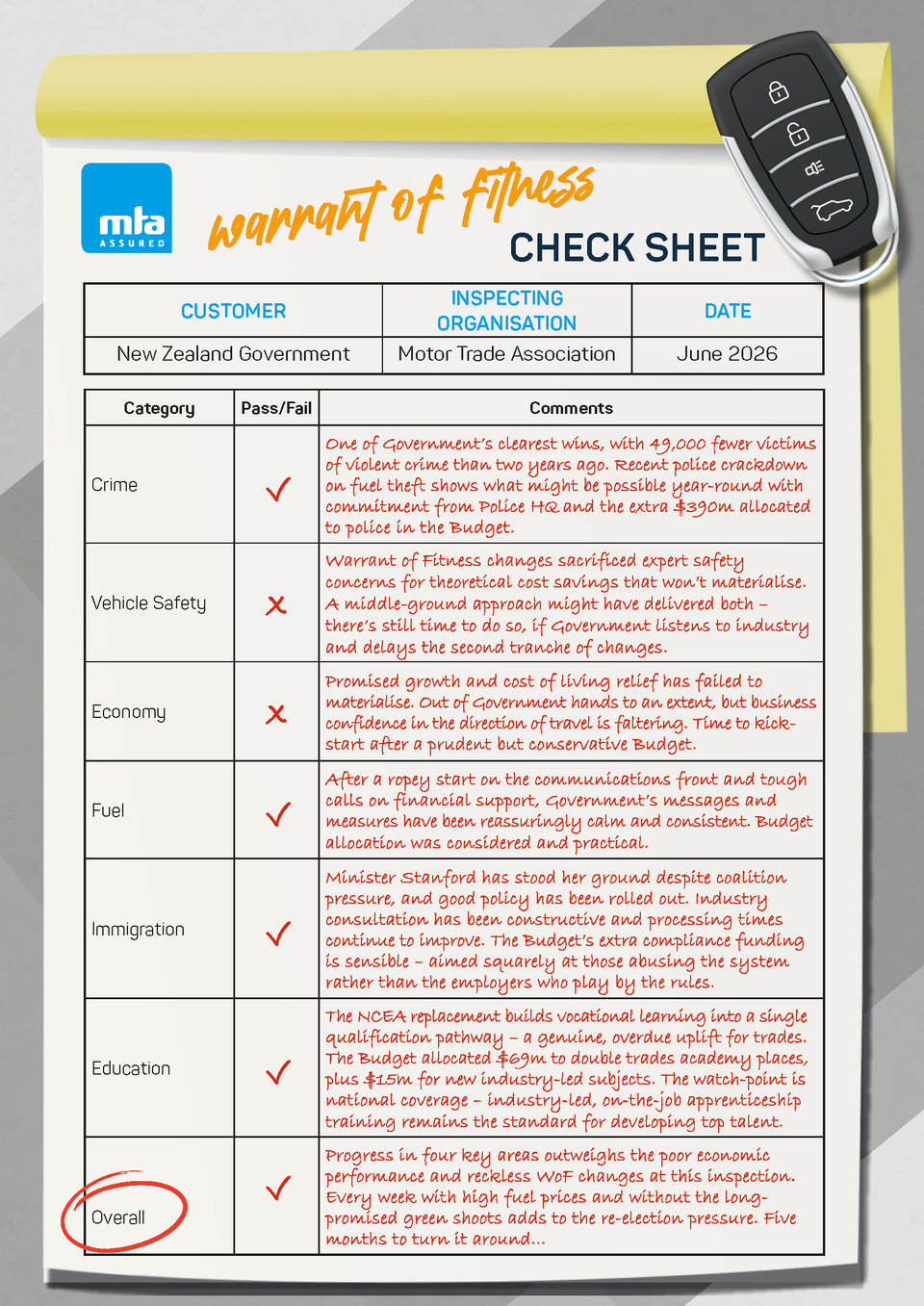
The New Zealand Government has received an overall pass mark from the Motor Trade Association (MTA) in its latest six-monthly assessment, though controversial Warrant of Fitness (WoF) reforms continue to draw strong criticism from the automotive industry.
The industry body handed the Government a fail grade for vehicle safety, citing its decision to proceed with changes to WoF inspection intervals despite opposition from many within the sector.
MTA head of advocacy James McDowall said the outcome reflected ongoing concerns among members, who carry out around 80 per cent of New Zealand's WoF inspections.
"There is possibly a degree of irony that the Government's own Warrant of Fitness reforms get a fail in the MTA's WoF inspection," said Mr McDowall.
"The reforms were a significant, serious issue for MTA members and industry and unfortunately the Government chose to go ahead with changes that were unsupported and unwelcome to many in the sector."

The Government's reforms, announced earlier this year, extend WoF inspection intervals for many light vehicles. New vehicles will now receive their first WoF after four years instead of three, while vehicles aged four to 10 years will move to two-yearly inspections rather than annual checks.
MTA has consistently argued the changes could have unintended consequences for both safety and household budgets. In an open letter published late last year, the association warned any short-term savings from fewer inspections could be outweighed by higher repair costs as faults go undetected for longer.
It also argued longer inspection intervals would increase the likelihood of unsafe vehicles remaining on the road.
Those concerns were expanded in a detailed submission to NZ Transport Agency Waka Kotahi, in which MTA said between 20 and 31 per cent of vehicles in the proposed four-to-10-year age bracket already present with safety-related issues when inspected. For vehicles aged eight to 10 years, the figure rises to roughly one in three.
The association also questioned the Government's assumption that fewer inspections would reduce costs for motorists, arguing delayed maintenance often leads to larger and more expensive repairs.
MTA's submission highlighted tyres, brakes, steering, and suspension as the most common areas where inspectors identify developing safety concerns.
The organisation supports modernising the inspection regime but has proposed a more conservative "3-2-2-1" model. Under that approach, the first WoF would remain at three years, vehicles would receive two consecutive two-year inspections, and annual inspections would resume once vehicles reach around seven years of age.
In its forthcoming election-year manifesto, MTA is calling on the Government to defer the new WoF frequency for vehicles aged eight to 14 years by two years while further evaluation is undertaken.

Transport Minister Chris Bishop has defended the reforms, arguing New Zealand's inspection regime is more frequent than those used in many comparable countries.
"Compared to other countries, New Zealand has very frequent inspections for light vehicles," said Minister Bishop.
"Modern light vehicles are significantly safer and more reliable, but our rules haven't kept pace, imposing unnecessary costs on motorists."
He said the Government's cost-benefit analysis projected between $2.6 billion and $4.1 billion in net benefits over 30 years through reduced inspection fees, less time spent on compliance, and fewer unnecessary repairs.

Despite its criticism of the vehicle inspection reforms, MTA awarded the Government positive marks in several other areas.
The association praised progress on crime reduction, describing it as worthy of a "big tick", while also commending what it called the Government's "reassuringly calm and consistent" communication around fuel supply issues.
Recent performance in immigration and education policy was also viewed favourably.
Economic performance, however, remains a concern.
Mr McDowall said the lack of the "long-promised green shoots" in economic data is increasing pressure on the Government ahead of next year's election.
"The Government has five months to turn that around," he said.
Under the new settings, changes to WoFs will come into effect in two stages. Implementation is subject to the completion of the Order in Council process.
From 1 November 2026:
From 1 November 2027:
Dave is a Kiwi motoring journalist with experience in motorcycle racing, new car sales, radio and communications.
Dave Kavermann
5 Hours Ago

Dave Kavermann
6 Hours Ago


Derek Fung
6 Hours Ago


Paul Maric
6 Hours Ago

Dave Kavermann
7 Hours Ago


Matthew Hansen
4 Days Ago
Add CarExpert as a Preferred Source on Google so your search results prioritise writing by actual experts, not AI.