BYD New Zealand has moved to reassure Kiwi motorists over how connected vehicle data is collected, stored and used, confirming owners retain ownership and control of all data generated through its Native Connect system.
BYD’s Native Connect system is a built-in connected service that transmits vehicle-generated data - such as odometer and diagnostic information - to cloud systems. In New Zealand, it is mainly used for fleet management and future digital road user charging, subject to customer consent.
Speaking during a Trans-Tasman webinar, BYD New Zealand general manager Warren Willmot said the system is built around a “data processor” model rather than ownership or commercial exploitation of customer information.
“Most of the data is generated by the BYD vehicle,” said Mr Willmot.
"It's operational. It's things like battery status, system diagnostics, vehicle performance. It's the same data that allows the vehicle to function safely, efficiently, and reliably."
“In many cases, the data isn't even stored on the vehicle long term. It simply enables the vehicle to do its job.”
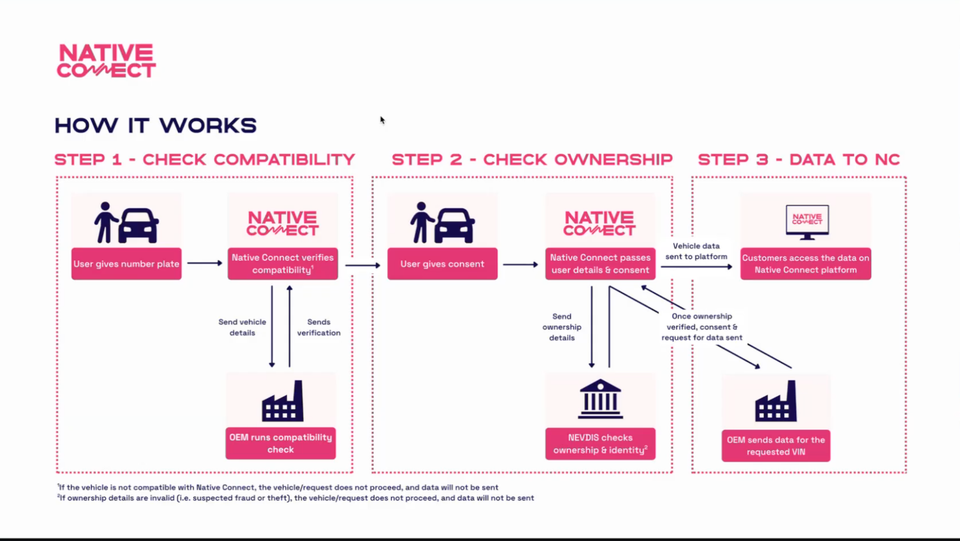
How the Native Connect system manages data.
He said personal data is kept to a minimum.
“When it's personal data involved, it's always minimal and purpose-driven. For example, in New Zealand, it's a VIN number and an email address and app login details that we give to BYD Australia to enable services like the remote access or the app.”
“Notably, we don't collect any sensitive personal data. There's no biometric data, no facial recognition, no invasive tracking.”
BYD says participation in Native Connect is strictly opt-in, with no data transmission unless customers sign a consent agreement.
The process includes defined use cases such as fleet management or road user charge (RUC) calculation, vehicle compatibility checks, identity verification via Australia's NEVDIS and registry datasets, and full terms outlining permitted data use.
Fleet operators remain responsible for ensuring drivers provide appropriate consent under employment and legal obligations.
Dave Corbett, chief product officer at Carbon, which is trialling Native Connect alongside traditional aftermarket telematics, said the platform is already helping reduce reliance on external hardware.
"The kind of data we need is the location of the vehicle, the speed and direction of the vehicle, what its odometer is, the state of charge," he said.
"All of those things are traditionally provided by aftermarket devices installed into vehicles."
Corbett said the shift to embedded connectivity is improving efficiency for fleet operators.
"If you don't have to install a device in a vehicle, then you've saved the cost of that device, but you've also saved the coordination time and the setup time."
Corbett said Carbon is currently running both systems in parallel to validate consistency.
"We've been using Native Connect alongside our existing devices... before we fully rely on the embedded data, just to ensure everything aligns."
Data stored in Australia, not China
BYD confirmed all New Zealand connected vehicle data is stored on Amazon Web Services servers in Australia, not China or other jurisdictions.
“For Trans-Tasman customers, BYD data is stored in Australia on Amazon servers. It is not sent or stored globally,” said Mr Willmot.
Native Connect processing is also handled onshore in Sydney, with customers able to exercise data rights including portability, deletion and erasure.
“Your data - that VIN number and email address - is stored in Australia. It’s not going to China. It’s not going anywhere globally,” said Mr Willmot.
Security and user control
BYD says its connected systems are designed with security built in from the factory, including encrypted communications, secure HTTPS (Hypertext Transfer Protocol Secure) protocols, role-based access controls, multi-factor authentication and ongoing vulnerability testing.
The systems are aligned with global automotive cybersecurity standards, including ISO and UN frameworks.
“Every BYD vehicle is built with security by design and secure systems, encrypted communications and strict authentication protocols embedded into the vehicle from the ground up,” Willmot said.
Crucially, BYD says owners retain full control over connected features, including the ability to disable services, reject updates, delete stored data or fully disconnect the vehicle.
“When it’s specific data like location services, that data is temporary and purpose-bound and it’s often deleted as soon as the function is completed,” he said.
“You can turn off these connected features. You can decline updates, you can delete your data, and if you’re really worried about it, we can even disconnect the vehicle entirely from the network.”
When a vehicle is sold or written off, BYD says it is automatically notified via NEVDIS and the vehicle is disconnected from Native Connect, with a 30-day window for data access before deletion.
Fleet focus and RUC applications
A key use case for Native Connect is automated road user charge (RUC) calculation, which BYD says is increasingly relevant in New Zealand’s transport funding system.
The platform can calculate RUC in the background and provide outputs for compliance and fleet reporting.
It also supports fleet management functions including live tracking, battery monitoring, trip data, odometer readings and diagnostic alerts.
Willmot said connected services are increasingly replacing traditional aftermarket telematics hardware.
“We’ve got about a thousand cars connected here in New Zealand and there is no cost to the trial,” he said.
“Any costs going forward are likely to be very minimal compared to the savings that you’re getting on telematics hardware rental costs.”
The system is currently operating in beta at no cost for participating New Zealand fleets, with BYD positioning it as a testbed for broader rollout.
“Connected data used responsibly can help you improve your fleet efficiency, reduce operational costs, enable smarter compliance and ultimately helps you make better decisions without compromising privacy,” Willmot said.
Trusted Reviews, Smarter Choices, Better Prices
Where expert car reviews meet expert car buying – CarExpert gives you trusted advice, personalised service and real savings on your next new car.



 Showroom
 Car Chooser
 Compare
 Car Specifications