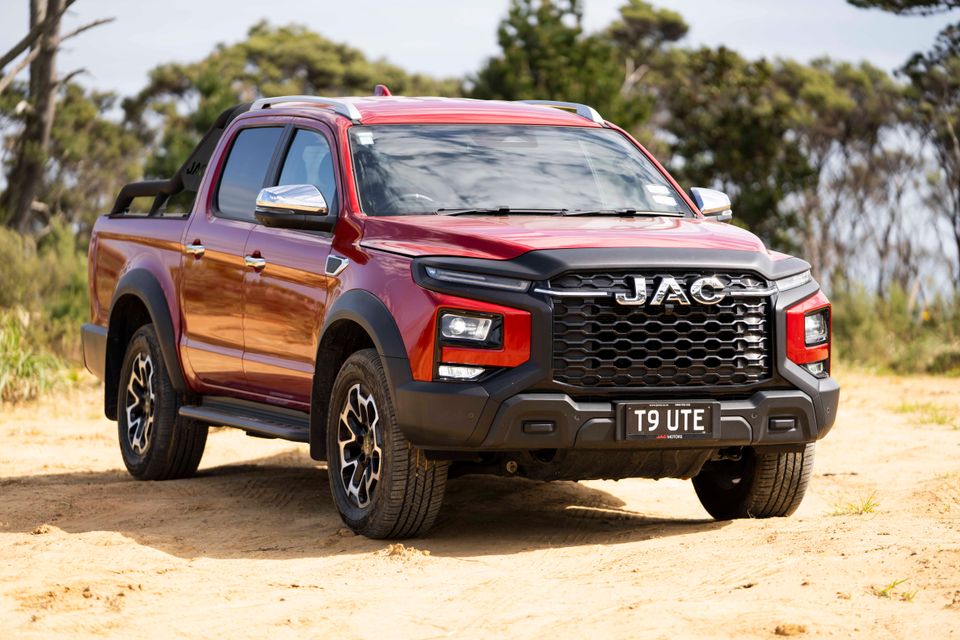
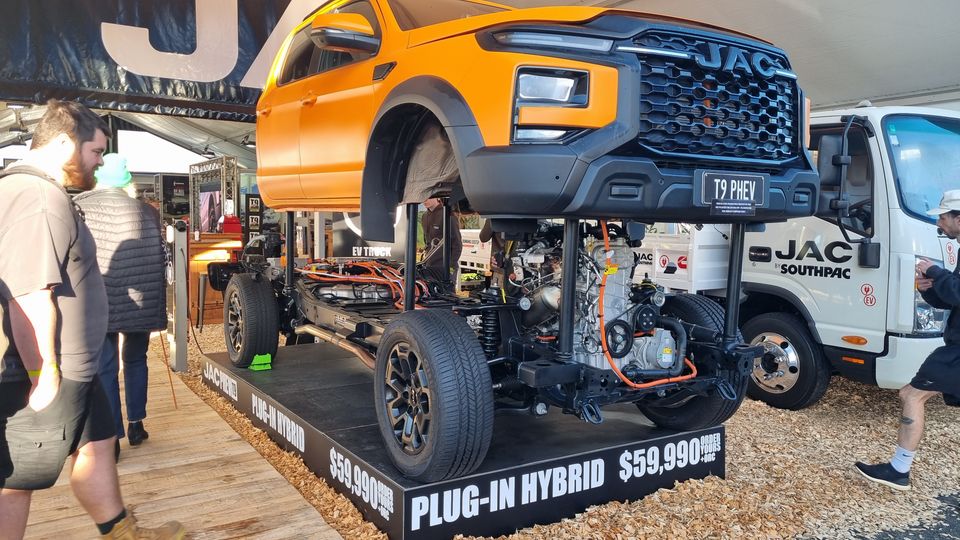
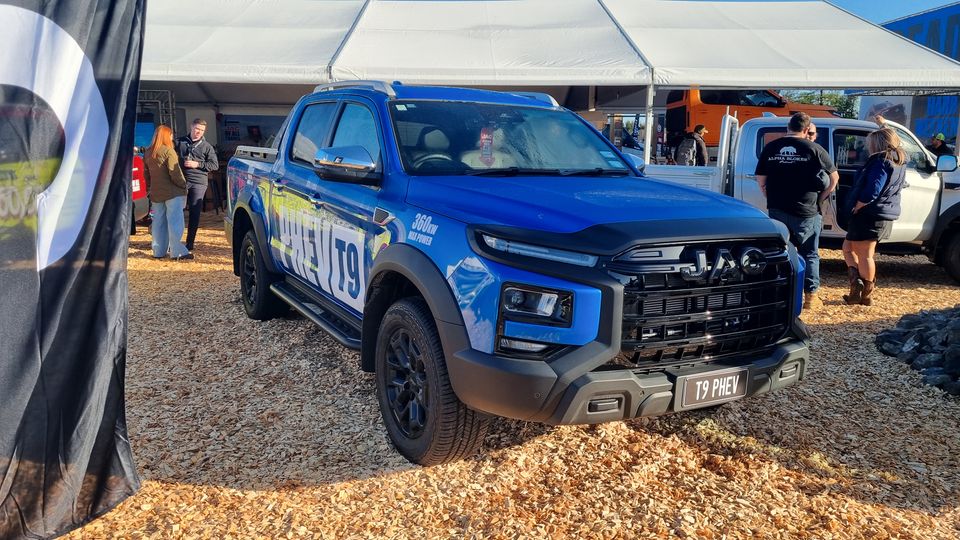
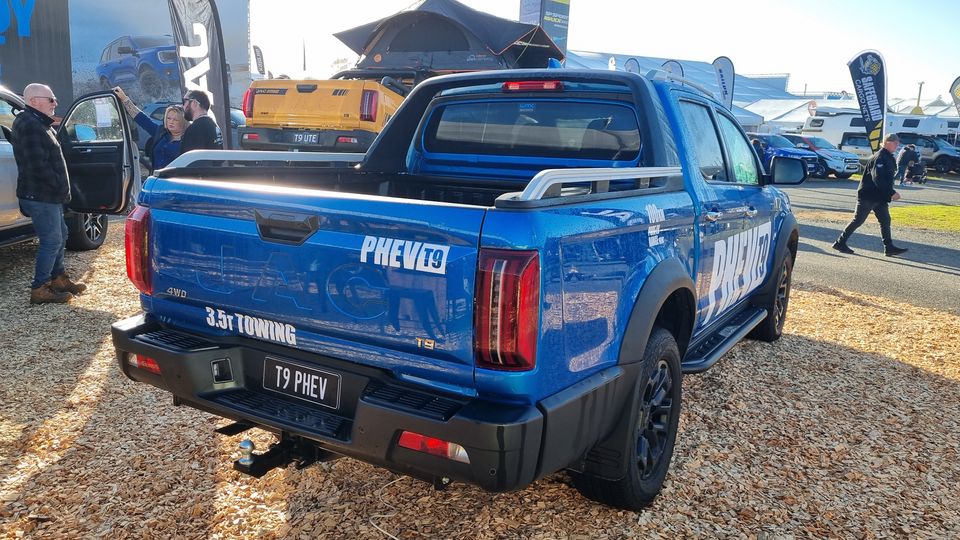
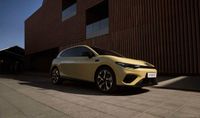
The JAC T9 PHEV has officially made its New Zealand debut at Fieldays, with the Chinese brand revealing full specifications and pricing for its electrified dual-cab ute.
Priced from $59,990 plus on-road costs as part of a limited-time launch offer, the T9 PHEV enters the market as the cheapest plug-in hybrid ute currently on sale in New Zealand, undercutting rivals such as the BYD Shark 6 and GWM Cannon Alpha PHEV.
The standard T9 diesel ute, which shares the same platform as the PHEV, is priced from $49,990.
JAC says the new model is not only the most affordable PHEV ute available locally, but also New Zealand’s most powerful hybrid ute, producing a combined 360kW of power and 674Nm of torque from a turbocharged petrol engine and dual electric motors.
Those figures slightly edge the 350kW of power produced by the Shark 6 Performance, but the JAC PHEV falls short of the BYD ute's 700Nm torque figure. Meanwhile the Cannon Alpha PHEV produces a claimed combined output of 350kW and 700Nm.
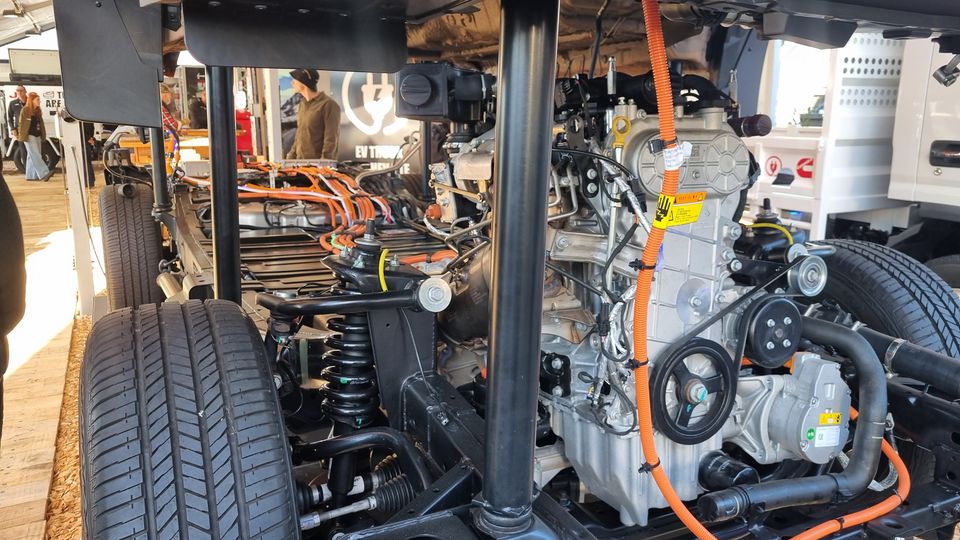
The powertrain combines a 155kW/370Nm 2.0-litre turbocharged four-cylinder petrol engine with a 130kW front electric motor and a 150kW rear electric motor. According to JAC, the T9 PHEV can accelerate from 0-100km/h in 6.0 seconds.
The brand claims a combined driving range of up to 1005km, including up to 100km of electric-only driving range under the more lenient NEDC testing cycle.
JAC says real-world testing in New Zealand has delivered promising efficiency results. While the official fuel consumption figure is 1.6L/100km, the company claims it recorded 2.6L/100km during a recent Auckland-to-Whangarei drive.
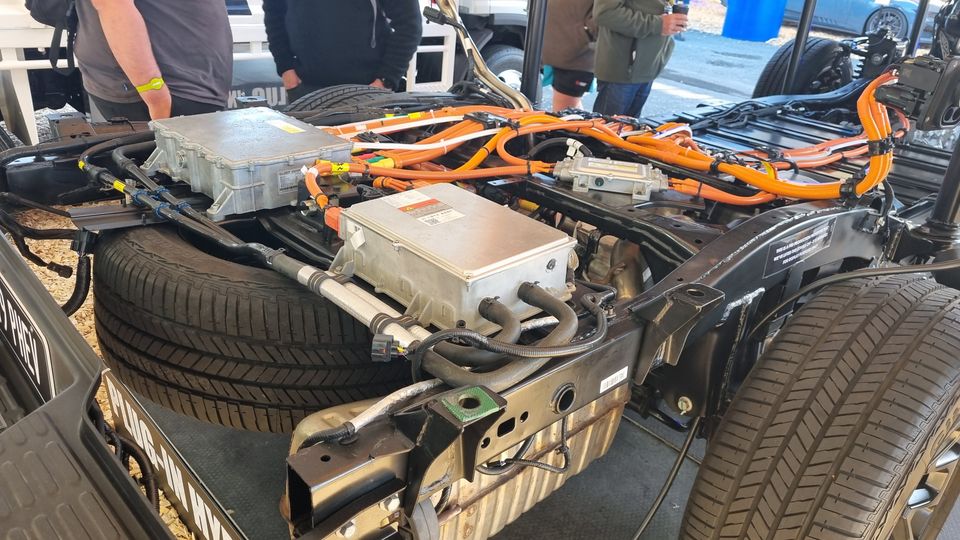
The ute features a 31kWh battery pack, which supports DC fast charging and powers a 3.3kW vehicle-to-load (V2L) outlet in the tray.
Unlike traditional four-wheel drive systems, the T9 PHEV uses an electrically driven rear axle with no physical driveshaft connecting the front and rear axles.
In EV mode, the rear motor powers the rear wheels through a solid rear differential. Additional traction is provided by the front electric motor and petrol engine when required, including in off-road driving modes.
Though it lacks a conventional low-range transfer case, the T9 PHEV features front, rear and centre differential locks, along with dedicated off-road and crawl modes designed to maximise traction.
JAC quotes a 550mm wading depth, while approach and departure angles are rated at 27 degrees and 23 degrees respectively. Importantly for ute buyers, the T9 PHEV retains a 3500kg braked towing capacity and offers a 915kg payload.
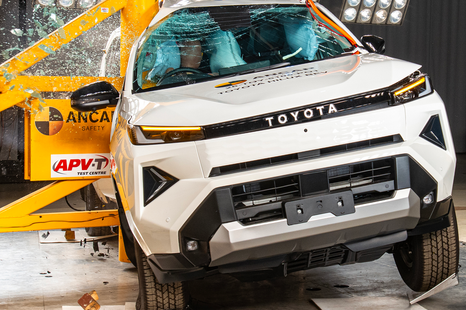
Safety is another key selling point, with JAC claiming the T9 PHEV is New Zealand’s safest hybrid ute thanks to its five-star ANCAP rating and class-leading crash test score.
Only one specification grade will be offered locally, based largely on the existing T9 Black Edition.
However, the plug-in hybrid gains several additional features including, wireless Apple CarPlay and Android Auto, wireless phone charger, soft-close tailgate, telescopic steering wheel adjustment and a surround-view camera.
JAC New Zealand says the first shipment of approximately 100 vehicles is expected to arrive between late July and early August, with pre-orders open now.
The company also expects the new plug-in hybrid variant to significantly expand the T9 lineup's appeal, with some dealers forecasting a near-even sales split between diesel and PHEV models.
JAC T9 PHEV pricing
Model | Price |
|---|
JAC T9 PHEV | $59,990 plus ORC* |
*Limited-time launch pricing.



 Showroom
 Car Chooser
 Compare
 Car Specifications